The trust cues are broken
Everything people were taught to check, the sender, the tone, a familiar voice, a face on video, can now be faked convincingly and cheaply.

Attackers now trick people into trusting AI, and AI into acting for people. A panel on the human-layer problems no single team owns yet.
The question we’ll debate
Binance, 2026. One engineer installed a fake version of a popular AI tool, another ran a fake recruiter’s “assignment”. Then the company’s own AI tool was used to reach colleagues. $6.4bn.
It is a trick question. The same attack now runs through both: the person is persuaded to trust an AI tool, and the AI is persuaded to act for the person.
Training matters, and it is not enough on its own. This panel looks at the human-layer problems no single team owns yet, and at the layers that have to work together to close them.
Everything people were taught to check, the sender, the tone, a familiar voice, a face on video, can now be faked convincingly and cheaply.
Business and vendor email compromise cost $3bn in reported losses last year, and AI now writes the perfect invoice, the perfect supplier and the perfect CFO.
AI assistants read the inbox and act for people. Trick the assistant and you have tricked the person, without a single click.
Agents can run a thousand personal lures overnight. Most defence still runs on annual training and manual checks.
Security owns the systems, fraud owns the payments, HR owns the training. Who owns the second before someone trusts?
Most spend sits around the decision, not on it.
Well funded and mature
The gap
Sources: Binance, Nov 2026; FBI IC3 2025 report; FBI (FaceStealer), Nov 2026; Vorlon CISO survey, 2026.
The spend is lopsided. Most budget protects the network, the endpoint and the inbox, while the moment a person, or their AI, decides to trust something is barely covered.
This is a working session for security, fraud and risk leaders, not a product pitch. You leave with a clearer view of where your human layer is exposed, and which layers to add first.
Binance in two minutes, then a live poll: who is easier to trick, your people or their AI?
Broken trust cues, deepfakes, and why the payment request is still the most expensive lie.
Who is “the human” when an assistant acts for you, and what changes at machine speed.
Security, fraud and HR each own a piece. Who owns the moment of decision?
We re-run the poll, each speaker names the one layer they would add first, then your questions.
Training that uses real, personal attack scenarios, including voice and video deepfakes, and shrinks the public exposure attackers draw on.
Real-time checks on messages, links, senders and payment details, in email and in messengers, with a plain explanation of what looks wrong.
Seeing which AI tools and agents act for whom, and checking each action against policy before it reaches data, money or systems.
A fast-moving and still early landscape: no single control is enough, which is why layering matters.
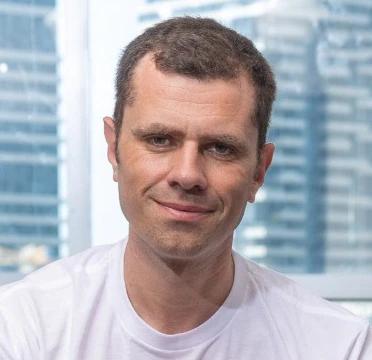
Speaker
Serial founder (CloudEndure, acquired by AWS). Now working on preventing autonomous AI agents from causing damage in the workplace.

Speaker
Builds cybersecurity tools for business and runs awareness trainings on AI-driven phishing, vishing and deepfakes.

Moderator
Former fraud and financial crime investigator, building protection for people at the moment of decision.
Live online
Thu 3 Dec 2026 · 15:00 GMT · 45 min + 15 min Q&A